|
Biospeleology of the Piemonte |
 |
Systematic Photographic |
|
Biospeleology of the Piemonte |
|
Systematic Photographic |
 |
|
 |
|
 |
 |
 |
|
 |
 |
|
|
|
|
|

An outline of Biospeleology
Ecology and environmental factors
Elements of Ecology
The whole of geographic areas adapted to the life of the
organisms is called biosphere; it
is constituted from the atmosphere, the waters and the ground.
The living beings are influenced from many environmental
factors and the physical characteristics of a certain ambient situated in one
geographic zone are determining and constitute by precise limits for
the life.
One geographic belt characterized by a predominant
vegetation that influences also the animal life is called biome and every biome has,
consequently, its characteristic species.
In every biome it's possible to identify different
ecosystems, that are the
bio-environmental units constituted by living beings that interact among
themselves and with the physical environment.
The ecosystem constitutes the integration of a
collectivity of several species (animals and vegetables), called biocenosis, with the environmental
space in which they live (biotop). The biotop is therefore the territory in which the
biocenosis lives and, whereas, the biocenosis is the whole of organisms that live
in the biotop. The biotop it therefore the fundamental environmental unit and it is topographically
possible to delimit it and it is characterized by the biocenosis
that live in it.
The environment is the totality of the external abiotic factors that form the
space in which the organisms move and live. The environment, in fact, cannot be
conceived without the living beings that populate it and that, in greater or
smaller measure, modify it: close relations and strong influences
exist between abiotic environmental factors and biotic factors.
The biotic factors, relative to the biosphere, derive from the qualitative and
quantitative presence of plants and animals; are biotic factors the single
individual, its population, the whole of various populations and the relationships among them (competition, predation, etc.).
The abiotici factors, are instead relative to the litosphere, to the atmosphere and the
hydrosphere, they are inorganic components whose influence can be highlighted through
the action of simpler components:
- the air, its
chemical composition, the pressure, the temperature and the humidity;
- the rock,
its morphology, the chemical and mineralogical composition, the structure, and sometimes also its spatial conformation;
- the water in
its physical states and in the phases of its cycle, that is evaporation,
condensation, precipitations and outflows over and under the land surface.
An other fundamental abiotic factor, by extraterrestrial origin, is the
solar radiation, that
acts directly and indirectly on all the biotic and abiotic components of a
system. In a speech of biospeleological subject in which the direct influence
of the sun would seem minimal, we must consider that in the first place the
water that has dug the caves, has been put in motion from the solar heat with
the thaw of the snows from which comes and that in a generalized manner, except certain bacteria, the
organisms that live in the caves consume the rests of other organisms that have
stored in the outside environment the solar energy in their bodies.
Usually an ecosystem has one natural border:
ecosystems are, for example, a particular meadow in a grassland, a water pool in
a beach subject to the tide, a decaying trunk in a forest or, in the hypogean
environment, an active gallery in which flows the underground river. An ecosystem can exist for a certain period of time, only if a delicate
equilibrium is established between abiotic and biotic factors.
The underground ecosystem, is delineated by precise features:
- the total absence or reduction of some
factors (like light, for example);
- the steadiness in the time of other
factors (i.e. temperature, humidity);
- the simplicity in the composition of
an animal population;
- the consequent simplification of the
synecological relationships (i.e. between the levels of
one alimentary pyramid);
- the greater degree of isolation
in respect to the contiguous ecosystems.
Hypothetical example
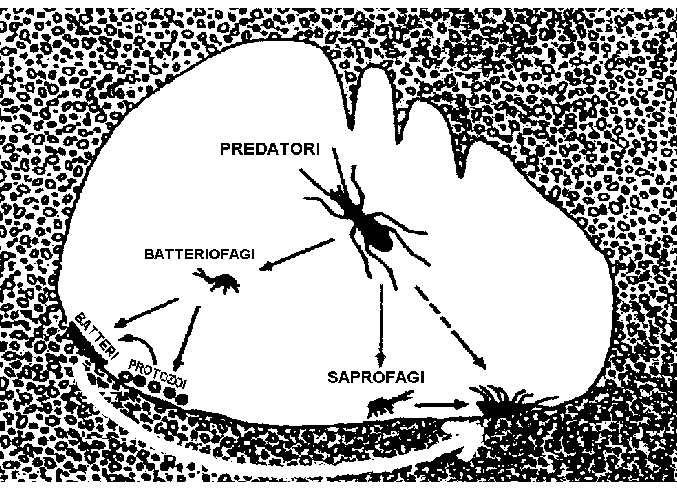
of alimentary chain in one cave In an ecosystem there are various spaces in which an
organism can live (i.e. the water of a pool, the mud of the ground, the cavern's walls, etc.). Every organism live therefore in
a particular portion of the ecosystem, it says that it has its habitat , that is the physical place in which the biotic and abiotic environmental
factors are congenial to the survival of the species
which it belongs. Moreover every organism, in its environment, supplies to
the own necessities in various ways (so we have organisms producers,
decompositors, predators, detritivore, etc). The whole of the relations
between organism and atmosphere constitutes its ecological niche . Obviously, two
species cannot occupy the same niche.
We must not confuse habitat with biotop: while the habitat is
the ideal place of life of an individual or a species, the biotop is is the real place of life of
a community of individuals or more species, that is of a biocenosis.
With the adjective "hypogean" we define the underground environment, the habitat of the organisms
living under the surface of the ground, while the "epigean"
environment is the habitat of the organisms living over the surface of the ground. Sometimes the separation
between the two environments isn't evident, not as well as from a
morphologic point of view, but rather from the ecological one. For example we can think to the
bottom of a canyon, the bottom of one little valley very deep or to the bottom
of one deep doline: there is little light, stabler temperature that in the
outside and probably a lot of humidity.
These environment are very similar to the liminar
zones of the caves (in proximity of the entrance), zones that, in the attempt to
make a subdivision of the hypogean environment, can be defined "of transition".
In the figure above the progressive letters A-B-C1-C2 indicate
the layers according to the pedological classification; the term "suolo" (ground) is
synonymous of rizosphere.
First of all we distinguish the endogean environment .
It represents the portion of ground comprised between the inferior limit of a detritus vegetable and the inferior
limit of the roots of the arboreal plants and for this is also called rizosphere;
it is the more superficial part of the ground in contact with the epigean
environment. Its aspect can be full of rocks, friable, gravelly, argillaceous,
often mixed, it depends of the geologic nature of the ground, the morphology, the
altitude, the vegetation and other factors; it can have thickness of little
decimeters, like in the alpine pastures, or of some meters, like in the boschive
valleys. Almost always this environment recalls the characteristics of the
hypogean environment, like the temperature, the humidity, the absence of light
and it represents for the fauna an ideal habitat being rich of humus and
of varied organic substances. Here lives the greater number of interesting species
from the biospeleological point of view.
Biologically, in base to the physiology and to
the morphology, we distinguish the subterraneaa fauna in two categories: endogean and cavernicole or hypogean.
In fact the endogean arthropods have a degree of specialization smaller than
the true troglobites and their stage less evolved represents one transition from the
epigean life to the hypogean. The endogean environment isn't clearly distinguished respect
to the contiguous sectors of the ground, and the endogean fauna is not easily
distinguished from the cavernicole one: we can see several stages of evolution,
and also species not clearly traceable to one or the other type of fauna.
The environment of cave or hypogean indicates
instead the cavities accessible to the man. A
satisfactory division of the hypogean environment could be gained from the
confluence of elements depending to the environment, but important from the
ecological point of view like the trofical situation, the hypogean meteorology,
the stratigraphy, etc, without to omit the morphology of the environment, but we
must remember that for an arthropod a cavity of 5 or 50 cm is not much
different, while for one speleologist the issue of the dimensions is essential.
According to the opinion of many authors (es. Racovitza), we
find, besides the endogean and hypogean, also the land interstitial environment, very
interesting, especially that labirinthic part of microfissures that operates
from natural filter of the exogenous contribution; it operate as a shelter for the more
delicate living forms, and it prevents to violent air exchanges between
outside and inside. A lot of persons think that the organisms founded in cave live only in
cave, but many species live in truth in the neighbouring interstitial environment,
from which irregularly they reach in cave. For this reason many arthropods of the hypogean
fauna are thought rare. The speleologist enters very rarely in
cave like the bugs, and that remarkably lowers the possibility of a contact.
However there is a particular fauna that needs the
cavernicole environment, because its way of life demands a larger space: as an example the
spiders for to weave their cobwebs, the troglophile grasshoppers for their
particular walking, some species winged of dipters and trichopters, the
bats.
The phreatic environment is the zone interested instead from the groundwater stratum; it
is often subject to seasonal variations of level as a result of
meteorological contributions and it interests the fauna mainly aquatic. The
rains in particular exercise a remarkable action of water connection between
several epigean and hypogean systems and determine one greater hygrometric
uniformity favoring these contacts.
Hypogean environmental factors We pass to examine more in detail the environmental factors
that influence the life in the underground environment.
The abiotic factors In the hypogean environment there are factors of primary
importance, that remarkably influence the ecology of the system; the
biocenosis is closely linked to the becoming of the same factors, for the
restrictive effecst and for the indirect action of evolution. Therefore the fauna of a cave is not accidental, but it
represents instead the result of a series of natural phenomena, of the
physical and chemical laws and still more of geologic events. Only the knowledge
of all this entirety can give answer to the multiple questions on the
composition of one certain biocenosis. Darkness, temperature, humidity are the abiotic factors more
important. These factors, being often constant for a sufficient period of time
(of the order of the millenia) are determining for the hypogean biological
evolution. Darkness : Without vegetation it lacks the primary production insured
outside by the green plants, and also all the phytophage organisms with its
parasites and predators. Exceptionally the production of organic substance is
present thanks to one meagre bacterial action. Sometimes we can found, also
in depth, sporadic fungi, which aren't plants, and don't produce from
himself the vital bases, but are saprophyte and they absorb
organic substance from dead organisms or in decomposition or also from alive
organisms (parasite fungi). The cavernicole fauna is therefore forced to found
elsewhere the energetic resources and shows adaptive
modifications of the metabolism. Many experiments are made in order to
assess the effects that the light causes on these organisms: for some
of them it has a lethal effect. The mole, insectivore, hunting in the endogean environment and
sometimes in surface too, but only at night: the visual apparatus is
reduced, but the sense of smell is very developed. Contrary in the Tarsius
(primate that lives in the Indo-china) the visual organ is very
developed, since it is insectivore and hunting bugs in thick and shady forests with insufficient
lighting while its sense of smell is limited.
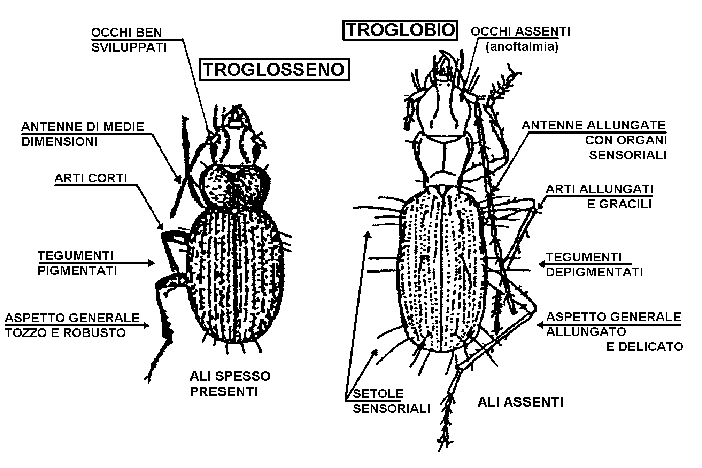
Moreover, the greater part of the true troglobites
shows a lengthened habitus, with slim body and long legs and antennas, covered of long sensory bristles for to compensate with an increase of
the tactile and olfactory senses the lack of the eyes that are useless in the obscurity. The difference is obvious if we confront
trogloxene epigean insects with the correspondents
troglobites that, even so they belong to the same family, they have evolved
for million of years in the hypogean environment. Other effects are recorded also in the metabolism: it disappears the alternation
of the day and the night, with modification therefore of the
Temperature : Normally the temperature of a cavity basement corresponds to the
average annual of the external temperature of the locality in which the cave is situated
and it depends therefore on the latitude and the altitude. It depends
also on the conformation and the depth of the cave: the ascending caves are
warmer than those descendants. In the deep caves very rarely we can observe an increase of the geothermal
degree with the depth: probably it is correlating with an
intense fissuration of the limestone rock that allows the infiltration of external air and
water. In the caves with more openings the
seasonal thermal variations influence the inner atmosphere considerably. The experiments have demonstrated that the cavernicole arthropods are not
strictly stenothermic (that is influenced by little variations of temperature):
some of them normally live to limit temperatures , therefore they can
survive within enough wide limits of temperature; some arthropods are able to bear changes of 10°C for periods of more days,
but this is possible only if the other factors, like obscurity and humidity, are constant. The temperature has an important role in the metabolism
of some species: as an example in the bats when they go into hibernation.
Humidity: Normally the cave's atmosphere shows values around 95% of relative humidity. There is a typical
seasonal course in the endogean environment, this is due to the fact
that it is in contact with the epigean environment and therefore to the external meteorological
situation; various species of arthropods is forced to migrations towards the
interstitial for having a favorable humidity; such species
very rarely are found in the cavernicole environment and a searcher that want to capture them must to dig to
the outside in May and June during the period of rains. The dry caves are generally azoic: the troglobites live
usually in conditions of humidity saturation and are therefore
stenohygre; they can die for small variations of the humidity degree; this is due to the dehydration. Every organism needs a certain degree of humidity and pressure that not always coincide to the environmental one. Those insects that in the summery period lives under the
cooking sun, without an appropriated exoskeleton, would die
dehydrated in little time. Some species (crustaceans) are so
adapted or preadapted to the strong humidity that can lead amphibious life,
but this advantage obligates them to a constantly humid environment. These three main factors (darkness, temperature, humidity) are locally influenced by other - -
without contributions from the external world.
Hypogean habitats 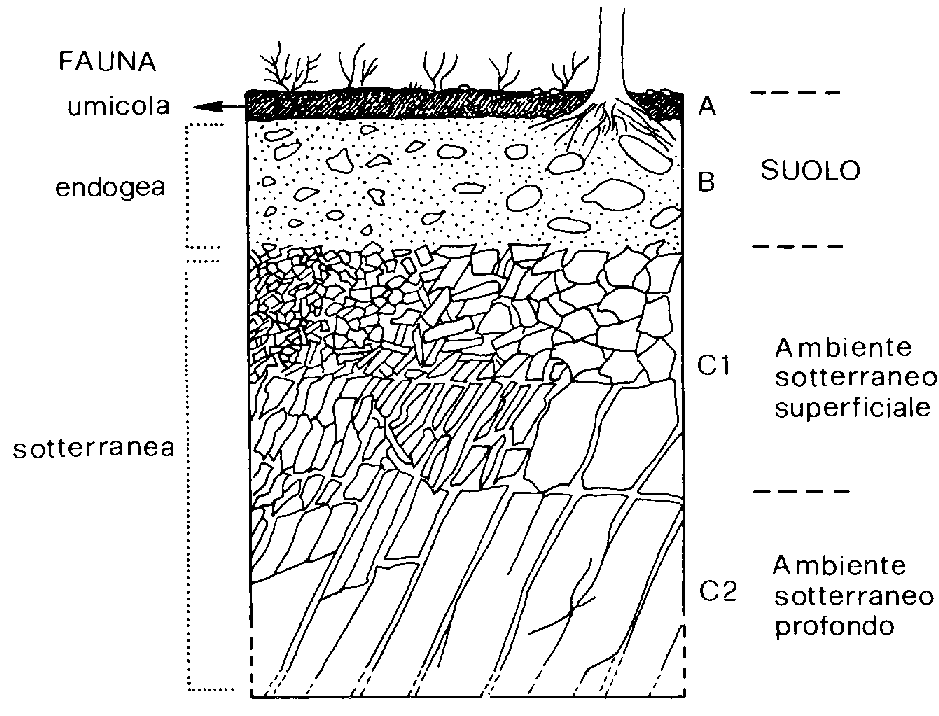
- geologic nature of the ground
(substratum, potential, stratigraphy, acidity);-
morphology of the cave (vertical, with wide doline opening or horizontal with small entrance).Other abiotic factors can be: the
chemical composition of the air and its state of agitation; the water, present as running water, firm water or dripping from the roof of the caves; the salinity and the pH of the water ; the lithological factors and the physical nature of the ground (granulometry, porosity, power of imbibition).
An outline of Biospeleology
 |
 |
|
 |
|
BIBLIOGRAPHY |
BIBLIOGRAPHY |
BIBLIOGRAPHY |

|
Biospeleo SUMMARY |
|
|
Systematic Index |
|
|


Some embellishments, Javascript, etc. have been modified
from them situated on the site 
"A SBAFO! All for the WEB gratis and in
Italian... "; the author advise you to visit it.


