Notes: this page is the translation of an Italian document. Being impossible to translate the images, it has been chosen to keep the original notations.
Here are the meanings of the following abbreviations:
cost.
= constant
CA
= Aerodynamic Center
CP
= pressure center
P
= Lift
CP
= lift coefficient
CR
= drag coefficient
The other symbols and abbreviations coincide whether in English and in Italian, and don't need translation. Have a good reading!
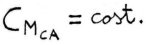
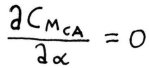
As known from the theory, the Aerodynamic Center, or Focus, is a fixed point, typical of each airfoil, in respect of which the moment coefficient remains constant when the angle of attack changes.
Or also:
But how was discovered that a point exists endowed with such a property? It's possible to see it in two ways. Let's examine the first one.
It is necessary to remember that an airfoil is characterized by some curves which have typical and well-known shapes: the CP-α curve, the CR-α curve, and the CP-CR curve (named "polar diagram"); but, if one remembers well, there is also a fourth curve, which gives the variation of the moment coefficient with the angle of attack: the CM-α curve. In measuring the moment coefficient, the moment is usually computed in respect of any point fixed to the airfoil (generally, however, placed on the chord).
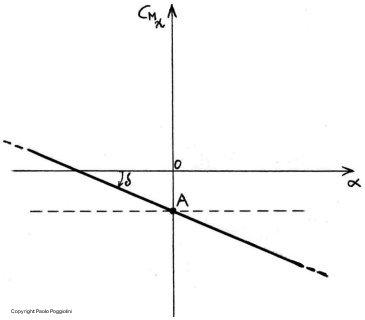
Well, remember that when the moment is calculated with regard to a generic point χ, the CM-α curve assumes the following shape: it's a straight line inclined of a certain angle δ in respect of the α-axis, and that intersects the CM-axis in the point A.
Indeed, the fact that the CM-α curve is a straight line (at least in its middle part, far from the stall) allows to demonstrate the existence of the Aerodynamic Center. The experimental aerodynamicists had already noticed a particularity: remaking the experiences, and changing only the reference pole of the moment, it came out another straight line which passed again through the point A, and had only a different slope, i.e. the value of the angle δ changed. Surprisingly, for certain points of calculation of the moments, the CM straight line inverted its slope, that is rather than descend rightward, it climbed rightward, or vice versa, yet passing always through the point A. This induced to suspect that a point existed somewhere, evaluating the moment in respect of which, the CM graph came a straight line of zero inclination, i.e. horizontal, always passing through the point A. This way, one would have found a point for which CM remains constant as the angle of attack α varies (fact expressed in the diagram just by the horizontality of the straight line), and with a value equal to the length of the oriented segment OA.
Therefore, any CM-α curve referred to any point χ identifies an oriented segment OA, and permits consequently to establish the value of CMCA.
But, in order to find where this Aerodynamic Center is (that is for finding xCA), is it compulsory to proceed by trial-and-error until the CM straight line comes out horizontal, or is there a quicker way? The answer, obviously, is that once again it is sufficient to draw only one CM straight line in respect of any point χ to find the position of the Aerodynamic Center, too.
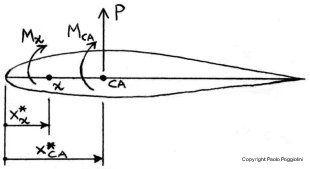
Let's consider the picture below, where we can see the airfoil with the generic point χ in respect of which the graph CMχ-α of the previous picture has been derived; let's suppose also the Aerodynamic Center exists, placed at a real coordinate x*CA, still unknown, and with the relevant moment MCA, and let's apply to it the lift P.
We obtain, adopting the usual convention of the moments positive when pitching up and negative when pitching down:
and, making the usual division by ½ρv2Sl:
and therefore
If the Aerodynamic Center really exists, then it must satisfy the property
so that:
(remember that ∂CP/∂α=CPα), and therefore, through simple passages:
But the quantity
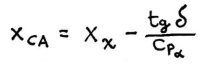
is nothing but the slope of the straight line CMχ in the initial graph, i.e. the tangent of the angle δ shown in the same graph. Therefore it is also possible to write, in a clearer manner:
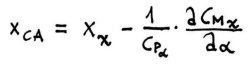
Here it is the position of the Aerodynamic Center!
So, at a single blow, we have demonstrated that the Aerodynamic Center exists, and we have calculated where it is.
A last interesting verification consists in demonstrating that the value of CMCA is given really by the oriented segment OA.
In fact, by replacing in the equation (1) the expression of xCA just found:
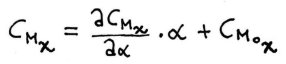
But CMχ had a rectilinear shape, and therefore in the graph CM-α was expressed by the equation of a straight line:
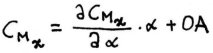
, where CM0χ is simply the ordinate at the origin, in other words the oriented length OA.
So we can write:
or also, for what already said:
Replacing in the equation (2) we obtain:
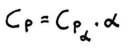
But CP, by definition, is nothing but CPα · α:
(remember that in the problems about stability we always consider the aerodynamic angle of attack, never the geometric one, therefore the term CP0 disappears from the formula CP = CPα · α + CP0).
Then, we arrive at the equation:
which is the result we looked for.
Now, let's see the second way by which the existence of the Aerodynamic Center has been proved.
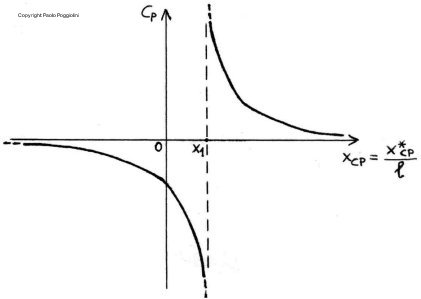
With the beginning of the scientific and systematic study about airfoils, the experimental aerodynamicists tried to plot the lift coefficient against the position of the pressure center, that is they tried to draw a graph having on the abscissa axis the (non-dimensional) position of the pressure center and on the ordinate axis the lift coefficient generated when the pressure center is just in that position. Great surprise, they found such a result in front of their eyes:
(as usual, in the point O there is the leading edge of the airfoil, and in the point xCP=1 it means that the pressure center falls upon the trailing edge).
Except the usual zones corresponding to the stall, the graph is a rectangular hyperbola having as horizontal asymptote the xCP axis, and as vertical asymptote not the CP axis, but the vertical straight line passing through the point of abscissa x1. Even by itself, this regular behaviour lets imagine the existence of a very special point endowed with equally special properties.
Let's start the investigation by observing that, if we move the origin of our Cartesian axes from the point O to the point x1, the rectangular hyperbola assumes the canonical form equation, of the type:
y = A / x
, where A is a constant which indicates how large or narrow the hyperbola is, and with the two branches of the hyperbola laying in the 1st and 3rd quadrant, that is to say the constant A is positive.
This translation of the reference system may be expressed by saying that in the original axis system the hyperbola has the equation
y = A / (x - x1)
In our case, since we haven't got x- and y-axes, but we have got xCP- and CP-axes, the equation is:
CP = A / (xCP - x1)
In the following, we'll see that the constant A assumes a quite special meaning.
If now we compute the moment coefficient that the lift produces in respect of a generic point χ, we obtain (making the usual simplification by ½ρv2Sl and adopting the usual convention for the moment sense):
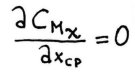
If, among all the generic points χ, there is one which is the Aerodynamic Center, it will also have to satisfy the relation:
since, if the CMCA is independent of the angle of attack, it must be independent of the pressure center position, too.
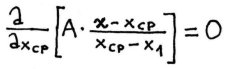
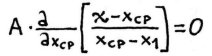
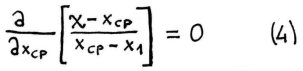
By replacing the equation (3) in the above derivative, we obtain:
and since A ≠ 0
It's a question of making the derivative with respect to the variable xCP of a quotient of two xCP functions: the numerator function is
, the denominator function is xCP - x1.
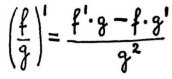
Well, given two functions f and g of any variable, if f' is the derivative of f and g' is the derivative of g, it's well known by the derivation rules that the derivative of (f / g), indicated as (f / g)', is expressed by:
By applying this simple rule at the derivation we have to perform, we find:
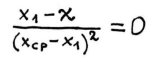
and this expression, for the equation (4), must equal zero:
, i.e.:
Therefore the Aerodynamic Center exists, and just falls on the point x1, in correspondence with the vertical asymptote of the rectangular hyperbola. So much the better!
And, to finish, the usual verification: once discovered where the Aerodynamic Center is, let's calculate the moment coefficient value in respect of it, so, at the same time, we check that it results actually a constant, independent of xCP (and consequently of α, too).
In order to do this, we must exploit the result found just now, and put χ = x1 in the equation (3):
Therefore the CMCA of the airfoil is nothing but the hyperbola constant A, with the opposite sign.
Every time that, testing an airfoil, we obtain a hyperbola laying in the 1st and 3rd quadrant (like the case shown in these pages), it means that the constant A is positive, therefore the airfoil is a normal lifting airfoil, with negative CMCA.
If, on the contrary, in the graph CP-xCP we had obtained a hyperbola with branches in the 2nd and 4th quadrant, the constant A would have been negative, and that would mean the tested airfoil was either an autostable or an overturned lifting airfoil, with positive CMCA.